- Home
- Scotland planning guide
- Driving in Scotland
Driving in Scotland
Licences, the first hours on the left, single-track roads, the rules that differ, and what to do when something goes wrong.
Licences, the first hours on the left, single-track roads, the rules that differ, and what to do when something goes wrong.
We live in Edinburgh and drive these roads all year, from the Borders to the Shetlands. This is what we tell our clients before they collect the car: the paperwork, the first hours on the left, the single-track roads that surprise British drivers too, the rules that change at the border, and what to do when a tyre goes flat on Skye.
Yes. UK, US, Canadian, Australian and EU licences are accepted for car hire in Scotland, and none of them needs an International Driving Permit. You need a full licence held for at least a year, and most hire companies ask for drivers aged 25 or over. If your licence is not in Latin script, the hire company may ask for a permit as well: we check it when we book your car.
Carry your licence and your passport. EU licence holders need the passport, since a national identity card is no longer accepted. The hire contract is between you and the hire company: its cover includes collision damage waiver, third-party and theft protection, and extras such as an excess waiver, a second driver or a child seat are paid at collection. Under 25? Tell us before we book, as some hire companies accept younger drivers for a surcharge.
If you usually drive on the right, we book an automatic unless you ask for a manual. The gear lever sits on your left in a British car, and one less thing to think about leaves your attention for the road.
Easier than most people expect. If you normally drive on the right, the first hour takes concentration, then the traffic carries you: follow the car in front and your place on the road reads itself. Remember one rule, the driver sits next to the centre line, and most hesitations go away. The moments that need care are the transitions: pulling out of a car park, entering a roundabout and turning right across traffic.
Plan the first day gently. After a long flight, collect the car, take a short first drive and keep the big Highland stages for the next morning. Set the mirrors before you move off and find the indicators: on some cars they swap sides with the wipers, and nearly everyone switches the wipers on at the first junction.
Already drive on the left at home? Skip to single-track roads and the rules. Those are the parts that surprise British drivers too, the drink-drive limit in particular.
Four situations, always the same ones. Drifting too far left in the lane, because the centre line is now on your right. Roundabouts, which run clockwise: you give way to traffic coming from your right. Pulling out of a car park or a lay-by with no traffic to follow, when the old habit takes over. And turning right, which means crossing the oncoming lane.
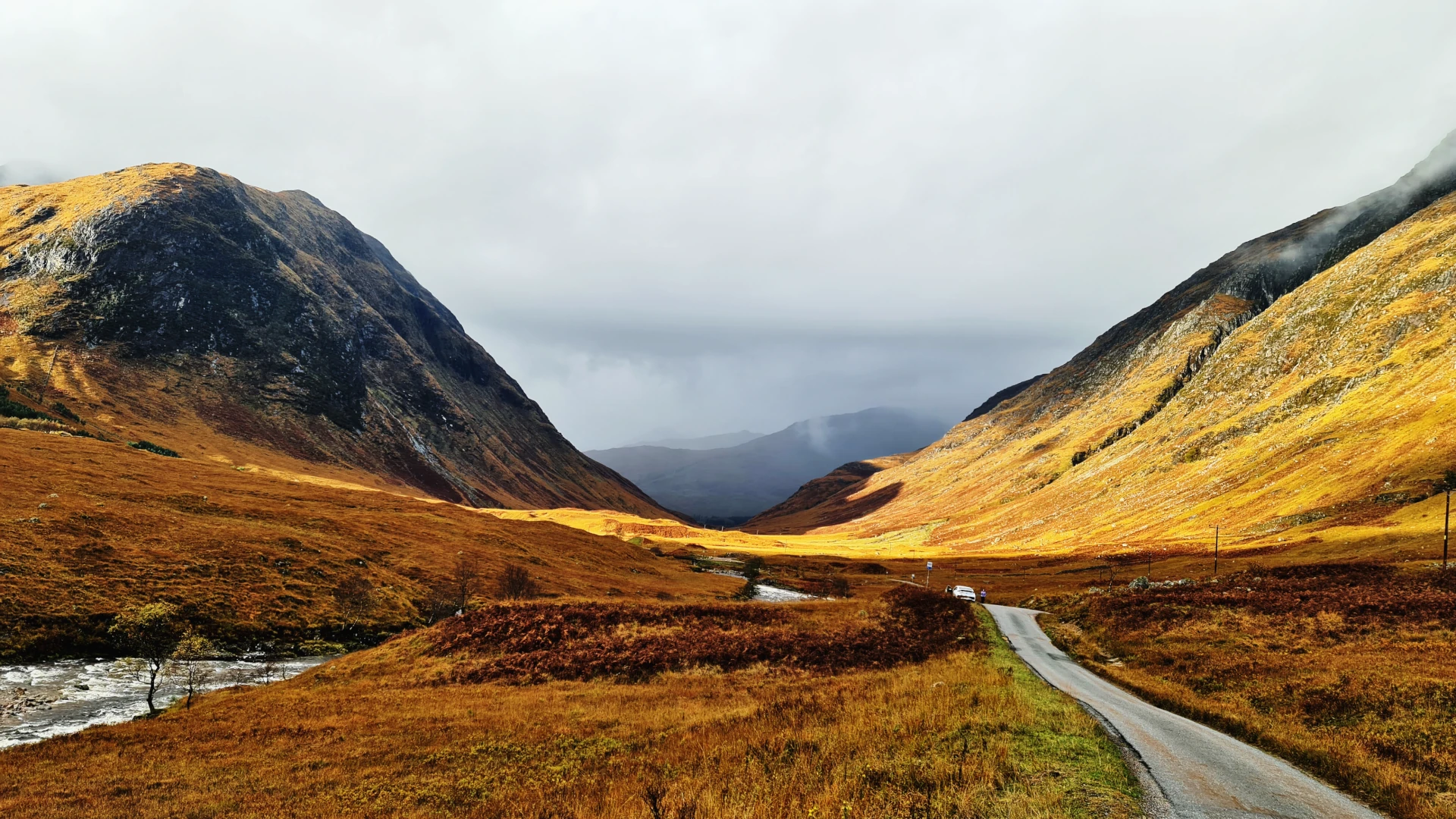
Much of the Highlands and the islands is served by single-track roads: one lane, with passing places marked by a "Passing place" sign or a black-and-white post. Pull into a passing place only when it is on your left; when it is on your right, stop opposite it so the oncoming car can use it. Use passing places as well to let faster cars behind you go by, and never park in one: they are for passing, and an emergency vehicle may need the space.
Speeds are in miles per hour: 30 mph in towns and 20 mph on many residential streets, 60 mph on single carriageway roads outside towns, and 70 mph on dual carriageways and motorways. The drink-drive limit in Scotland is 50 mg of alcohol per 100 ml of blood, lower than in England and Wales, so a single pint can put you over it: our advice is none at all. A handheld phone is illegal at the wheel, seat belts are compulsory for everyone, and children need a child seat until they are 12 or 135 cm tall. Scotland has no toll roads or toll bridges.
| Road | Limit | In km/h |
|---|---|---|
| Towns and villages | 30 mph | 48 km/h |
| Many residential streets | 20 mph | 32 km/h |
| Single carriageway outside towns | 60 mph | 97 km/h |
| Dual carriageway and motorway | 70 mph | 113 km/h |
A lower limit on a sign always wins. At junctions, priority is shown on the road rather than by who comes from the right: a broken double white line with GIVE WAY painted on your lane means you give way, and with no marking in front of you, you are on the main road. Give cyclists room, at least 1.5 metres when you pass.
Driving up from England? The drink-drive limit drops at the border, from 80 mg to 50 mg per 100 ml of blood. Taste the whisky in the evening, once the car is parked.
Less far than the map suggests. On a single-track road, 25 miles / 40 km can take an hour, so plan stages in hours rather than miles and leave time for stops. Filling stations thin out in the north and west: on the North Coast 500 the longest stretch without one is about 46 miles, and many close early or on Sundays. Fill up whenever the tank drops to half.
Fuel is sold by the litre. In early October 2026 the UK average was about £1.75 a litre for petrol and £1.99 for diesel. Your hire car will usually run on diesel: check the label inside the filler flap before you fill. What a week of fuel adds up to is on our Scotland trip cost page, and our North Coast 500 Grand Tour shows the far north in stages of three and a half hours or less.
Sheep, deer and sometimes Highland cattle on unfenced roads, with deer most active at dawn and dusk. Weather that turns from sun to rain and fog within the hour, and stopping distances at least double on a wet road. Mobile signal that drops out in the glens, so download offline maps before you set off and note the address of the night's stop. And no street lighting: plan to arrive before dark.
In winter, snow can close the Highland passes, and your travel book carries an alternative for the days it does. In June the opposite applies: light until after 10pm in the north, and the temptation to keep driving. Stop anyway.
Pull over somewhere safe, off the road if you can or into the next passing place, switch on your hazard lights and get everyone out on the side away from traffic. Then call the hire company's roadside assistance number, with the registration number and your exact position ready. In an emergency, call 999. If you are travelling with us, message us on WhatsApp once you are safe and we rearrange the rest of your itinerary.
Sharing your location on WhatsApp is the quickest way to say where you are. Without data, give the road number (the A82, say), the nearest village, loch or castle, and the postcode if you can see one on a sign. Your travel book carries what3words coordinates for every stop.
Most punctures start on the left edge of the road: stone verges, potholes, loose gravel. Keep the car centred in its lane, slow down where the road narrows, and stay off soft verges when you park or turn.
Then leave the wheel to us. A private guided tour puts one of our driver-guides at the wheel for the whole trip, from £4,000 per person per week based on four sharing. Or base yourself in Edinburgh and take day tours: £650 for a full day, one price for one to eight travellers. Both are private to your own party.
See the three circuits on our private guided tours page, and the six days out on our day tours page. Happy to drive after all? Our self-drive tours are planned with realistic stages and a travel book that tells you where to fill up.
Prices shown in GBP. Foreign currency equivalents are indicative and updated daily. Contracts and payments are in GBP only.
The rules come from the official sources below, checked on 18 October 2026. The advice comes from our team, who drive these roads every week of the year.